A one-paragraph history
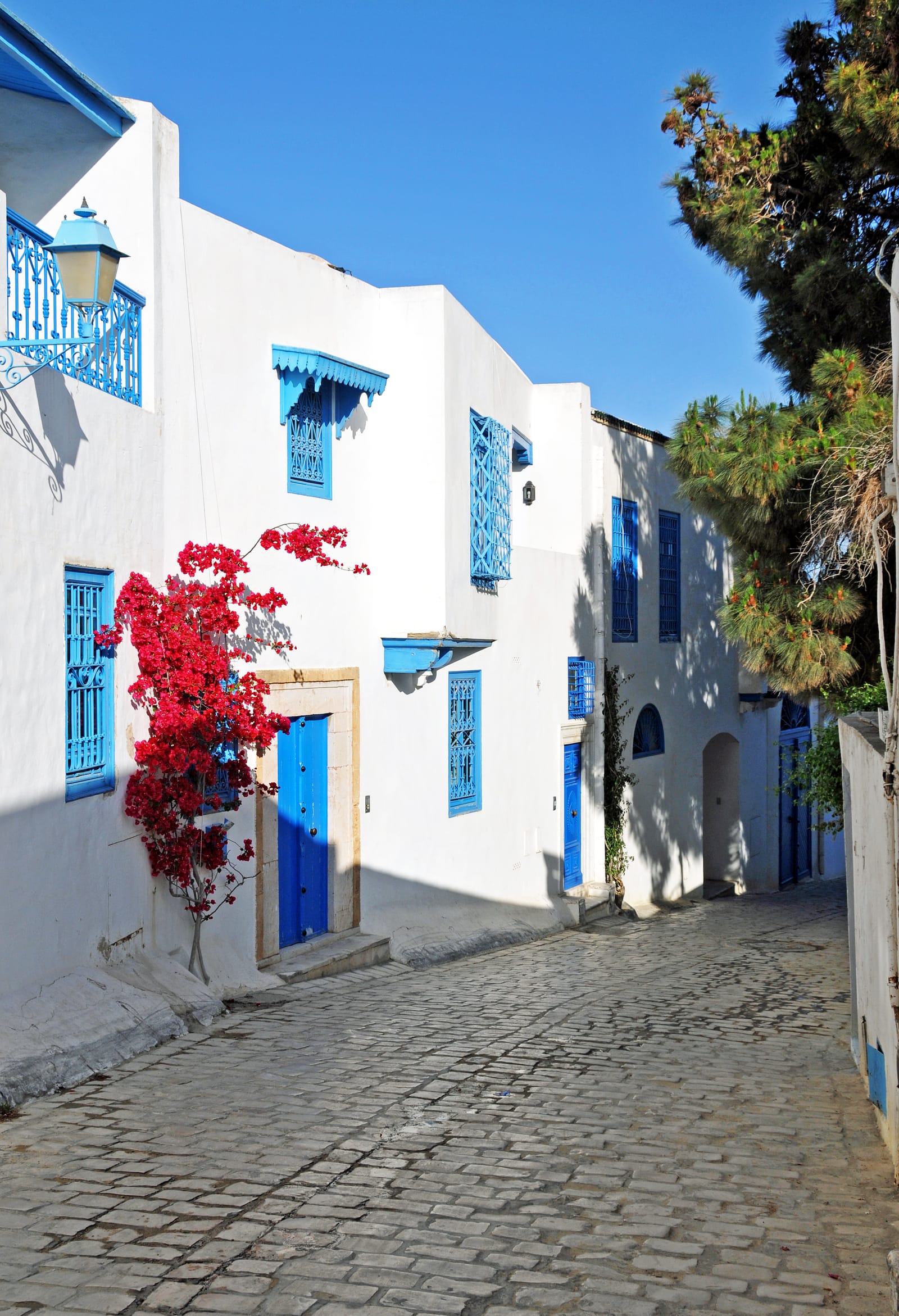
The headland has been occupied since the Phoenicians — Carthage is on the next hill, and this cliff was its lookout over the gulf. In the 13th century a Sufi teacher from Béja, Abou Said al-Baji, settled here; a village grew around his tomb and took his name. It stayed a small fishing and pilgrimage settlement until the early 20th century, when the painter and musicologist Rodolphe d’Erlanger built his palace on the lower slope and persuaded the authorities to protect the village’s whitewash-and-blue palette by law, in 1915.
That law made Sidi Bou Said what it is. Klee and Macke painted here in 1914, Gide and later Beauvoir and Sartre passed through, and by the mid-century it was an artists’ colony with a cliffside view. Today it is a working Tunisian town of a few thousand people that also happens to be the most photographed place in the country.
The perfect half day
Arrive at nine. Walk up Rue Habib Thameur while the street is still empty and the light is clean, stopping at the studded doors and the mashrabiya windows. At the top, climb the blue staircase to the Café des Nattes for a mint tea with pine nuts on the mats.
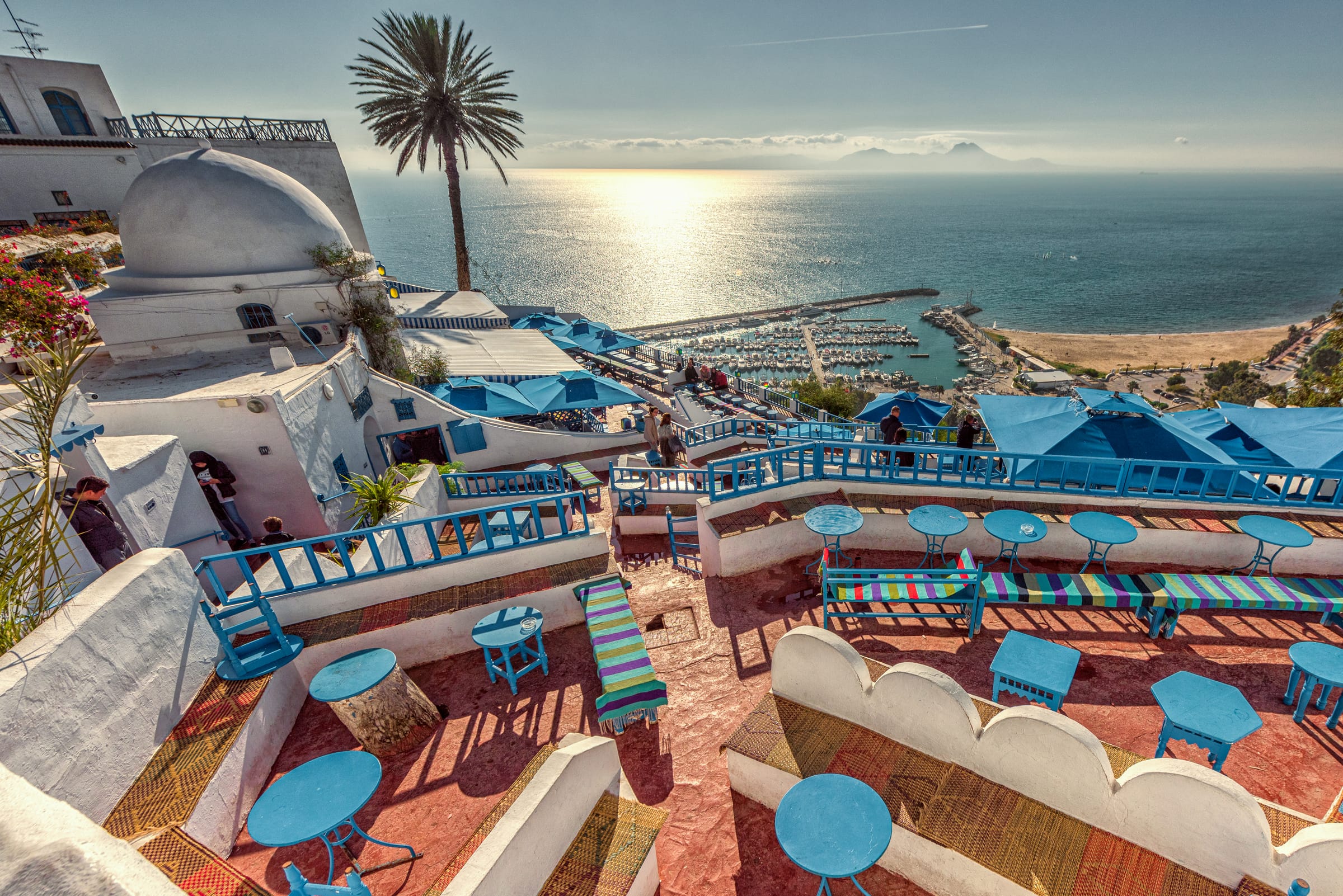
From the square, walk out along the lighthouse road for the view over the gulf, then come back down and turn into Dar El Annabi to see inside a traditional house and, more importantly, to stand on its roof terrace. Finish with the artisan shops on the way back down, and a bambalouni doughnut at the stand by the steps.
The perfect full day
Do the half day above in the morning. Add the Ennejma Ezzahra palace on the lower slope before lunch — allow an hour for the gardens and the instrument collection.
Lunch at the marina: walk down (fifteen minutes, steep) or take a taxi, pick a fish from the ice, and eat it on the quay. Swim off the little beach if it is warm.
Come back up for the late afternoon — taxi if it is July. Sit on a clifftop terrace above the marina from about an hour before sunset, then walk the lanes during the blue hour, when the lanterns come on and the whitewash turns lilac. That last hour is the reason to stay the night.
What to eat and drink
Mint tea with pine nuts (thé aux pignons) is the local ritual, served everywhere and best on a terrace. Ask for it "pas trop sucré" unless you like it syrupy.
Bambalouni — a hot doughnut fried to order and rolled in sugar — is sold at the stand near the café steps and is among the best cheap food in Tunisia.
Brik is a crisp, paper-thin fried pastry with a whole egg inside, usually with tuna and parsley. Eat it carefully. Grilled fish at the marina is the other essential; agree the price by weight first.
Alcohol is served in some hotels and restaurants but not generally in the village cafés. Tap water is chlorinated and locals mostly drink bottled; bottled water is cheap and everywhere.
What to buy
Nabeul ceramics, birdcages (the decorative Sidi Bou Said kind), olive wood, silver filigree, woven rugs and jasmine posies (machmoum) sold by hand in summer.
Prices in the village are tourist prices and bargaining is expected: open around half, settle near two-thirds, and stay good-humoured. The workshops on the side lanes are better value than the stalls on the main street, and the fixed-price state craft shops (ONAT) elsewhere in Tunisia are a useful reference for what things should cost.
Money, language and practicalities
The currency is the Tunisian dinar (TND), which is a closed currency — you cannot buy it before you arrive and you should not try to take much of it out. There is an ATM by the roundabout at the bottom of the village; the cafés and small shops at the top are cash-only more often than not.
Arabic is the national language and French is widely spoken and used on signs; English is common in tourism but not universal. A few words of French go a long way here.
Tunisia is generally relaxed about dress, and beachwear is fine at the marina. In the village, and especially around the mosque square, covered shoulders and knees are appreciated. Friday midday is the main prayer time.
The village is safe and busy with families well into the evening; standard city sense applies. The main practical hazards are the gradient, the cobbles and the midday sun.
What to combine it with
Carthage is four TGM stops away and is the obvious pairing: the Antonine Baths, Byrsa Hill and the Punic ports on one ticket. The Tunis medina and the Bardo Museum make a second day, and La Marsa two stops north is where you go to actually swim.
The efficient version of all of that is a guided day that sequences the Bardo, the medina, Carthage and the village — which is what most of the tours on this site are.